Writing back to Myrtle: How “Winkle” was Won
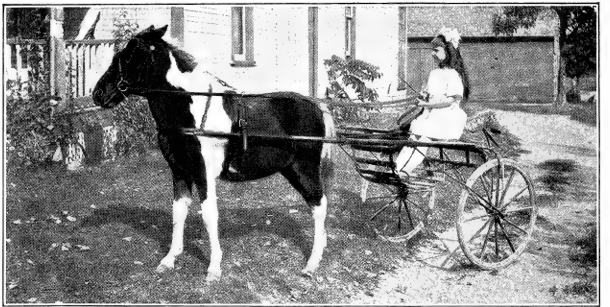
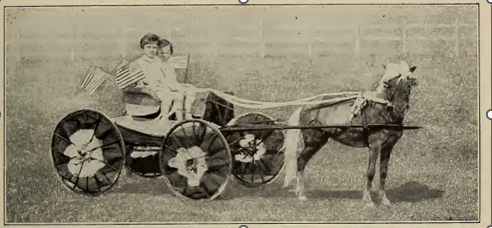
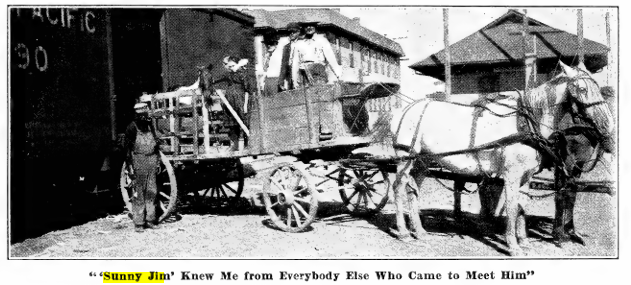
In the early 1900s, a little girl named Myrtle won a pony named Winkle. Here is an excerpt from her letter:
When I received your good letter, telling me I had won “Winkle,” I just leaped for joy and clapped my hands. I ran to the telephone and told my aunt I had won “Winkle” and his outfit and she was so overjoyed she ran about one-half mile across a cornfield to break the news to grandpa about my success. Aunt is a large fleshy woman and just imagine how funny she looked running across the cornfield to break the news to grandpa. And when she told him he threw down his hoe and up with his hat and called to my uncle and said, “We will stop right where we are and do no more work today, but will go over and spend the evening with Myrtle Pearl and sit up with her tonight, for I know she won’t sleep any.” So on they came and several of my friends came too and we had a regular jubilee.
But the best of all was on June 9th. The mail man was at the station when “Winkle” came in. He led him out and on to my home that evening 14 miles distant. When he got to the post office is where the true happiness was expressed. I was so happy I almost cried. I hugged “Winkle’s” neck, talked to him and we were perfect friends from the very beginning.
If I could write back to Myrtle, here is what I’d say:
Dear Myrtle,
Your grandpa sounds like a wonderful, fun grandpa! He dropped everything to wait with you until the arrival of Winkle? Oh, what a joyful memory for you! He must have had a big smile on his face.
Your grandpa being in a cornfield to hear the news of you winning your pony reminds me of my own grandpa. It sounds like your grandpa was a crop farmer, just like mine. I wonder what crops your grandpa grew. My grandpa grew field corn, seed corn, and soybeans. One year, my grandpa grew wheat next to his house. My aunt Lynn taught us to stand on the top of the wood fence that aligned the wheatfield. Then, we would jump as far as we could into the wheat (so as not to show the “entry point” to our mischievousness). We would crawl all through the wheat on our hands and knees and make paths. The wheat was easy to knock down. I doubt that my grandpa was very happy about us knocking down a lot of his wheat.
I wonder if you spent your childhood in wheatfields and cornfields, too?
When I was a little girl, my time was not spent at the beach, or within a cul-de-sac riding bikes with the neighborhood kids, or even at a golf club running around a gleaming in-ground pool. (Myrtle, a cul-de-sac is where people choose to live in houses that are built around a circle of cement. And, yes, now we have in-ground swimming pools that contained crystal clear water by dumping chemicals into the water).
When I was your age, my time was spent roaming the cornfields, woods, and swamps that my grandparents owned. Was it the same for you?
I lived “next door” to my grandparents – which meant if you were a bird and flew straight from my house to my grandparents’ house, you would only fly a quarter mile. If soybeans were planted in the fields in the summer or when the corn was picked from the fields in the fall, I could see my grandparents’ house from my backyard. On a quiet fall evening, I could even hear the corn bin dryer’s engines making their loud, low hum. This sound meant that the corn was picked for the year, and my grandpa could focus on deer hunting.
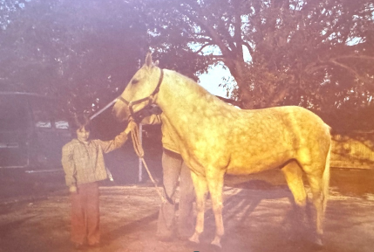
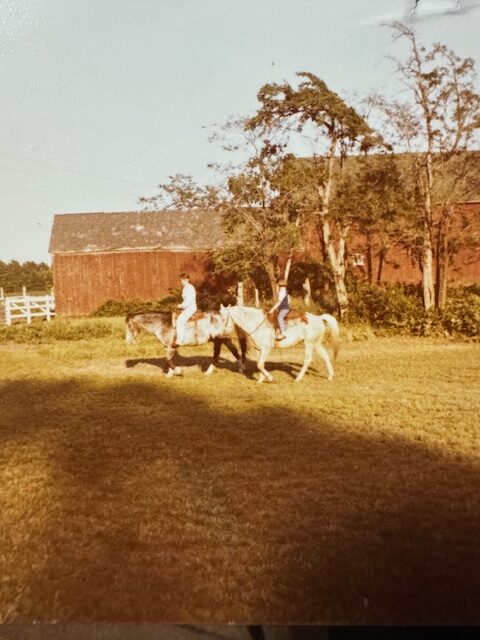
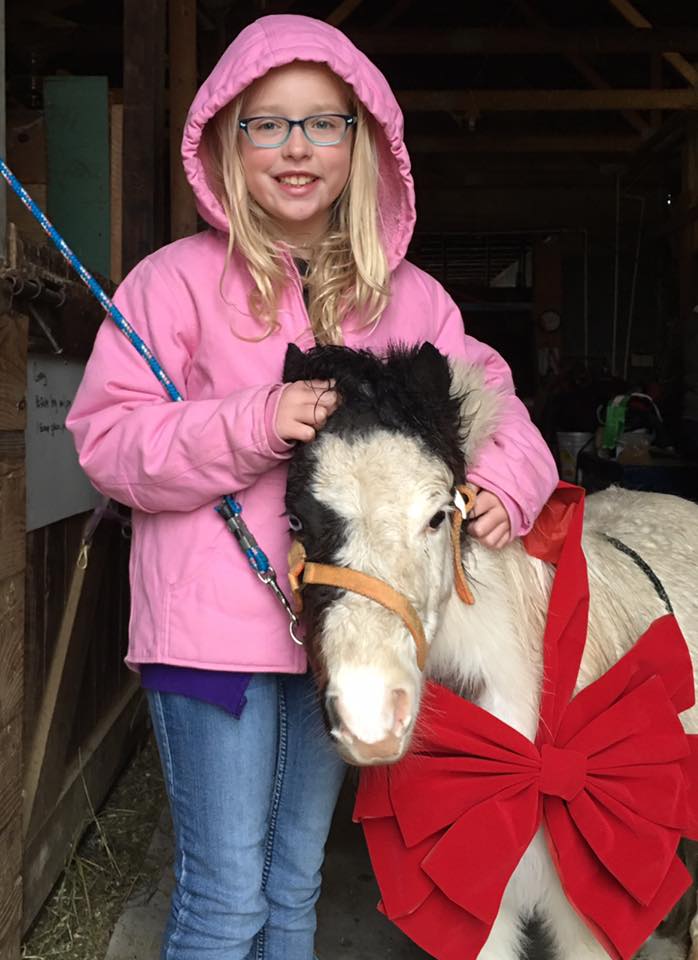
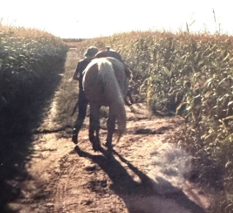
While it was an easy drive by car from my parents to my grandparent’s house, my path as a non-driver to my grandparent’s house was always through the cornfield. And I took this path many times a day, especially when school was out during the summer. The irrigation rows were my highway. I traveled on foot, by pony, and by Honda.
What is a “Honda?” you may ask. We called our motorized 3-wheeled ATVs, “Hondas.” The body of the Honda had an ATC90 sticker on the side of them. Other people called them “90s,” but we called them Hondas. For my young aunts, cousins, and I, the ponies in our pastures and three Hondas in my grandparents’ barn were our tickets to freedom.
You know what it’s like to ride a pony, let me tell you what it was like to ride a Honda.
For the Hondas (and other farm machinery, I suppose), my grandpa even had his own gas pump at his house by the large pole barn and we helped ourselves to endless supply of gasoline. I knew how to pump gas into a Honda before I learned about my multiplication tables. I cannot begin to tell you how often we overfilled the gas tank, and the gasoline came spilling out onto our hands. While some girls were learning about perfume and polished nails, I typically smelled like a truck stop. A mix of gasoline and engine exhaust was the fragrance of my youth. With the wind whipping my chronically tangled hair from the saddle of my pony or from the seat of a Honda, I looked road-weary too.
We were so young when we started driving the Hondas that I would have to press on the gas on the right handlebar as my aunt Lynn would pull the rope to turn over the engine. We worked together. Even though Lynn was a few years older than me, and stronger, she couldn’t do both at the same time. Our ticket to freedom for the day was to learn how to be in perfect sync so that it only took one try to get the Honda started. Without cooperation, we were stranded in the yard.
“Ready?” She would ask me. A 2-handed strong pull of the rope starter by Lynn near the engine and a quick burst of gas by me on the handlebar, and we would hear the sweet, consistent sound of the low rumble from the engine of the Honda. Off we would go.
We would be gone for the entire day. The Honda had large, balloon-like tires and seemed to handle any surface; it even easily made its way through large mud puddles without getting stuck, over large branches with barely a bump. With three large wheels, the Honda turned on a dime. In one grandpa’s woods dodging trees? Not a problem. Flying down a dirt road with the gas wide open? Go for it.
The only negative we could see on the Honda was that the hot engine was at calf-level, and I cannot tell you how many times we burned our legs on the engine. It is a miracle that we do not have scars on our legs as adults.
If we had a cousin visiting and we did not particularly care for him or her, we would not warn them about the hot engine. This lack of shared information usually resulted in a burn on their calf. It was an initiation into our Honda-riding club, I guess.
Eventually, Lynn got strong enough to start both her Honda and a Honda for me to ride on my own. At the peak of Honda ownership, my grandpa had three available for us to ride. Somehow, they mysteriously were always serviced and ready to go. A flat tire? Someone fixed it. In need of oil for the engine? Someone did that too. The Hondas were originally purchased so that my grandpa and his farming help could check irrigation, but I do not ever recall even seeing an adult on our Hondas. Instead, the Hondas were ours and the focus of our lives (second only to our ponies).
On these endless, Honda-filled days, mom thought that I was spending the day at my grandma’s house and my grandma thought we were spending the day at my mom’s house, and Lynn and I did not think to tell either of them any different. In reality we were off pulling nail spikes out of an old railroad track, jumping our Hondas over giant earthen ramps (reality: small hills that barely gave us a lift off), swimming in one of the irritation ponds, hunting for morel mushrooms, swinging from a rope in our great-grandparents barn, exploring the dilapidated old family school house, or simply touring our family’s endless farm fields named “Grabers,” “Felkers,” “Brumfields,” “the hay field,” and so on. We swam in irrigation ponds called the “L Pond,” “Lake Margean,” and “Grandpa Lloyd’s.” We did not wear helmets. Our sustenance was a Schwann’s Push-Up (Orange Sherbert flavor) from grandma’s freezer coupled with a squished Fruit Roll-Up from our pocket. Water came from a hose. We had the wind on our faces and an endless day ahead of us. Even the pesky deer flies could not catch up to us on our Hondas.
Our ponies side-eyed us from their pastures. I imagine our Honda exploration days were a happy respite from us.
After the long days of adventure, we parked our Hondas in the late afternoon and dragged our dirty, sunburnt, tired bodies out to do our “chores.” We smelled like gasoline and had branches in our hair. But the ponies didn’t mind, and the ponies had to be fed. Lynn knew what my ponies were to be fed, and I knew what her ponies were to be fed so we helped each other with our chores. We had unspoken roles and went straight to our work.
Somewhere along the line, someone decided that these vessels of freedom and fun – our beloved Hondas – were dangerous. The sale of 3-wheelers was banned around 1988. Fortunately for us, we had grown up by then. Three-wheelers turned into quads. And “good parenting” turned into helmets and curfews.
So, Myrtle, thanks for mentioning your grandpa in the cornfield. It brought back memories of my own grandpa and the wheatfields, woods, cornfields, and irrigation ponds that I spent my childhood transversing on my ponies and on the Hondas. There may be over one hundred years between us, but I think we grew up in a remarkably similar way.
Warmly,
Regina
p.s. If I had ever called any of my aunts “fleshy,” I would not have lived to talk about it! 😊