“Writing back to…” (The Lucky Pony Winners): What you’ll find in some of my blog posts ❤️
My grandparents lived on a dirt road surrounded by the farmland that they owned. Near the kitchen in their two-story white farmhouse with green shutters, there was a window over a built-in desk. Through that window, you could look down their dirt road to the west and just barely see the main paved road that intersected my grandparent’s road. The intersection was about a half mile away. The dirt road that my grandparents lived on was more like their personal long driveway than a public thoroughfare as few cars actually went beyond my grandparent’s house. On the rare occasion that a car or truck went past my grandparent’s driveway, someone would ask, “I wonder who that was?” Grandma and Grandpa’s farmhouse was always the logical destination. What was worth visiting beyond 26333 Butler Road?
As you pulled into grandpa and grandma’s driveway under the canopy of four tall pine trees separating the gravel from the grass, you were usually greeted by grandpa sitting at the picnic table with a beer in his hand (Drewery’s was his first choice but he eventually moved to Miller Lite). You always found an unlocked door to the house. Even if grandpa and grandma weren’t home, you could walk right in. Their house was the center of the universe.
Before I could drive, I rode the school bus to grandma’s house after school every day and waited for my mom to pick me up. My mom was a 2nd grade teacher in a neighboring school district. I would look out that window over the desk to see if she was on her way, stuffing grandma’s saltine crackers into my mouth as my after-school snack. The first thing that you could see to signal an impending car was a very small dust cloud in the distance. The dust cloud would grow larger and larger until you’d eventually spy the grill of a car.
As a child herself, it was through this very same desk window that my mom also spent many hours looking to the west down the dirt road to see who was on their way to visit. It was her greatest wish that it was someone on their way to surprise her with a pony. That was her dream. Every dust cloud brought the possibility that her dream would come true.
While a surprise pony delivery never happened, my mom eventually was gifted her first pony, Poncho, from an uncle. Poncho was a small pinto pony; brown and white. Backyard quality. Beloved by all who met him. Poncho was delivered in the bed of a pickup truck. The bed was fashioned with high wood railings to keep Poncho, or any livestock, from jumping out of the truck. As the oldest daughter, so began my mom and her sisters’ adventures with Poncho, Lucky, and Stubby.
My mom’s story of wishing for a surprise pony to be delivered to her house stuck with me. My mother’s love for ponies has never waned and she instilled that respect and deep appreciation of ponies in me. Both of us have owned and shown horses, but ponies have a special place in our hearts. I’ve often been guilty of being a keyboard warrior on behalf of ponies on social media when ponies are described as being naughty, small devils. Is there a stinker in the bunch? Sure. But ponies are nothing short of patient, courageous survivors. I am empathetic to their plight.
Let me explain.
Ponies are an important first step to introducing youth to the horse industry. Height, bulk, and power can be scary. A tall 1200-pound horse looks a little too big and strong on which to sit a small, inexperienced child.
Parents often turn to ponies as a child’s first mount.
Yet, who do we put on ponies? Unbalanced, inexperienced, and nervous kids who send mixed messages to the pony. The tug and pull between the pony and its unseasoned, unknowing rider continues until they finally become a team. And what happens when those kids finally figure out what they are doing? We “move them up” to a horse who is blessed with a better rider. What happens to the pony? Most likely, the pony is handed off to another inexperienced, unbalanced kid who sends mixed messages to the pony. It’s an endless cycle for the pony. No wonder they can become brats. Any equine, short or small, deserves to acquire a way to ensure self-preservation (even if self-preservation means running said child under a low-hanging branch).
In 2021, Lynn Cool and I began our podcasting adventure with the Horse Industry Podcast. The podcast has grown into a burgeoning equine media company. We’ve talked to a lot of people within a variety of niches within our horse industry. We’ve interviewed people who show pleasure horses, hunter-jumper horses, and cutting horses. We’ve chatted with people involved in the racehorse industry, with equine art gallery owners, and with equine authors. We’ve met with trainers, farriers, vets, and barn owners. The one thing we all have in common – regardless of where or how we enjoy horses now – is that we all remember our first pony (usually, with great fondness and, often, with a chuckle).
Ponies were the gateway to our equestrian lifestyle. And we all went through the same gate. Reminiscing about our ponies brings smiles to our faces. Ponies are the thread that connects us all.
Having an appreciation for history and a background in academic research, I began searching for interesting stories about ponies knowing that the content would appeal to all our listeners. As I began to dig through stories and documents, I had no idea that I would stumble upon an unbelievable story of a Minnesota-based publishing company giving away over 325 ponies in the early 1900s to children in 36 states.
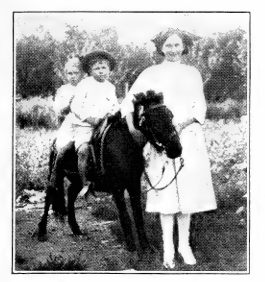
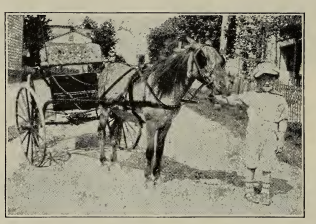
The free ponies, and their “outfits,” were the grand prize to children who sold the most The Farmer’s Wife magazine subscriptions for the Webb Publishing Company across the United States during a given time period (usually a couple of months at a time). This “Win a Free Pony!” competition began 1907 and ended around 1918. The winners were a part of The Farmer’s Wife Pony Club whose motto was “A Pony For Every Boy and Girl.” This circulation promotion was a tremendous success for the publishing company and the letters submitted by the children provide us with a window to life, and to pony ownership, in the early 20th century.
Yet, the “win a free pony” competition was not without its naysayers. It was not uncommon for ambitious children selling magazine subscriptions in small towns and along rural roads to come across well-meaning adults telling the hardworking kids that their efforts were hopeless as no company was actually going to send a real, live pony to them for their efforts. Even some of the children’s parents were highly skeptical. These were discouraging words for children whose greatest hope was to earn a pony of their own.
Even today, when I mention the existence of such a competition and prize, the information is met with disbelief by my own contemporaries.
I will admit that putting a live pony in a crude box (the size of which the pony was unable to lay down) and shipping it off via train to a child and his or her family with no formal vetting program sounds totally irresponsible and unbelievable.
At times, the pony traveled for multiple days in the box until it reached its destination. Yes, the box included hay and water at the start of the journey, but who checked on the pony and its feed along the way? While it seems that most of the ponies were actually retrieved from the train depot, what happened to the ponies that were not claimed?
Sometimes, the children were aware that they had won a pony. Other times, the pony was a surprise delivery (my mom’s childhood dream). What fate did the pony find upon reaching its new home? Were the pony’s owners educated on how to take care of a pony?
Like many horses of the day, the ponies were simply the means to an end for the Webb Publishing Company. As long as children sold magazine subscriptions, the publishing company would keep putting ponies in crates on a train and send them to their fate. Hopefully, they all lived a good life and it was a happy ending.
At some point during the promotion, the Webb Publishing Company realized the negative narrative floating around about whether their pony competition was a farce. The publishing company asked the pony-winning children to write to them, sharing their good fortune and happy times with their prize ponies. This would “prove” to the public that the publishing company, indeed, sent real live ponies to the children who worked hard to sell magazine subscriptions.
The children who wrote back to the Webb Publishing Company often found their letters published in a special section of The Farmer’s Wife called “Lucky Pony Club Winners.” These letters confirmed that the children did receive their pony and the competition was, in fact, a legitimate program.
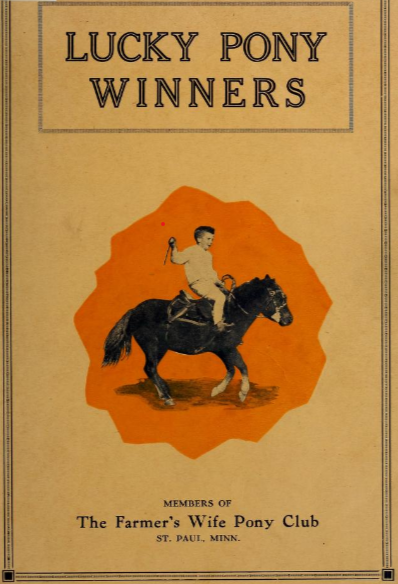
Eventually, all the letters from the pony-winning children were compiled and published in 1915 in a book called Lucky Pony Winners. Through the letters, we are able to take a glimpse into the past of life with ponies.
As I read through the hundreds of letters sent in by the children who won ponies through the competition, I felt compelled to speak with them, asking them questions and connecting with them as a fellow pony enthusiast. I saw myself in their excitement and appreciation for their beloved ponies. So that’s what I did. I wrote them back.
In pages that follow, we are given a unique lens into how life with ponies was over a century ago and I take the role of an unlikely pen pal. I connect some of the themes from their letters with my own lived experiences as a pony-loving child from the 1970s and 1980s and as the mother of pony-loving children from the 21st century.
Through our letters, there are stories of hope and stories of loss. Stories of happiness and stories of fear. There are even whimsical stories of poorly written poems and efforts to make the best darn lemon butter cake in the world (or at least the best cake around a New Year’s Eve party table in Michigan).
I do have one simple wish. For anyone, young or old, who yearns for the companionship of pony, it is my sincere hope that you look out the window one day and see a truck and horse trailer kicking up some dust on an old dirt road on its way to surprise you with a pony of your own.
Warmly,
Regina
p.s. Enjoy the stories!